


DEFACING THE PAST
Everything has changed yet nothing has changed. The modern world has gone mad. The heroes we once looked to in order to reinforce cultural ideals are now vilified by an increasingly decaying ecosystem where anti-culture has taken hold. Societies, once bound together by common beliefs and customs, have been pitted against each other. Every tie that binds has been undone.
A common belief in what constitutes a hero is a cornerstone that provides people a way to publicly enshrine their moral makeup. It’s no coincidence that heroes the world over are being “reimagined” by those wishing to redefine them in their image and enshrine a new order. The scope of this campaign’s failure has been monumental leading to catastrophic corporate collapse across multiple industries. It all could’ve been avoided and I predict that a new culture will be rebuilt from the ashes, largely owned by those brave enough to help lay bricks of their own.
A WORLD IN TURMOIL
As Bane states in The Dark Knight Rises: “Victory has defeated you.” First-world nations—coddled by technological wonders and relative peace—indulge nonsensical beliefs which are counterintuitive to civilizational preservation. The sexes have been pitted against each other in the domains of industry and social discourse. Pursuit of money and career has supplanted the pursuit of companionship, family and contentedness. Influencers flaunt their moronic lifestyles to the masses of short attention span doomscrollers. We no longer desire to save ourselves; we just want to be distracted from watching the slow collapse of everything around us.
Growing numbers of young people are disillusioned, losing faith in a system they feel powerless to influence. Men are taking their own lives in epidemic numbers and women are attempting to do so in similar quantities. We’re at an impasse of spiritual bankruptcy that materialism cannot address.
In ages past, it was the moral compass of heroes that guided us forward and gave us a guiding light to follow. In modern times, such heroes are vilified as remnants of a corrupt past that we should be ashamed of. It’s no wonder that in light of this, many wander aimlessly with no cultural foundation upon which to stand and believe in.
The consistency with which ethics, morals and values are now applied is contradictory, aimless and seemingly non-existent in many cases. Certain activist organizations and media outlets carry morally repugnant and unconscionable views that go unchallenged. Nothing makes sense anymore. Those meant to be inspired by heroes have no functional moral compass to relate to them.
What we need is a media culture that once again celebrates heroes—people who accept incredible risk to preserve something larger than themselves. That is the standard we’ve chosen to abandon.
THE LAST VESTIGE OF HEROES
A hero charges into situations of near-certain doom in order to protect those who cannot protect themselves: an innocent child, a village of farmers, a starship filled with astronauts in stasis, something.
The last attempt to distill the concept of western heroism into an easily-digestible formula was the Marvel Cinematic Universe. The overarching storyline was about a group of disparate individuals driven by humanistic ambitions—some selfless and others self-serving—consumed with power, wondering how best to employ it. The rolling arc of character drama and universe-splitting, high-stakes storylines offered global audiences a summation of thousands of years of heroic poetry condensed into a macro-arc that spanned a decade of film releases. And guess what? It worked.
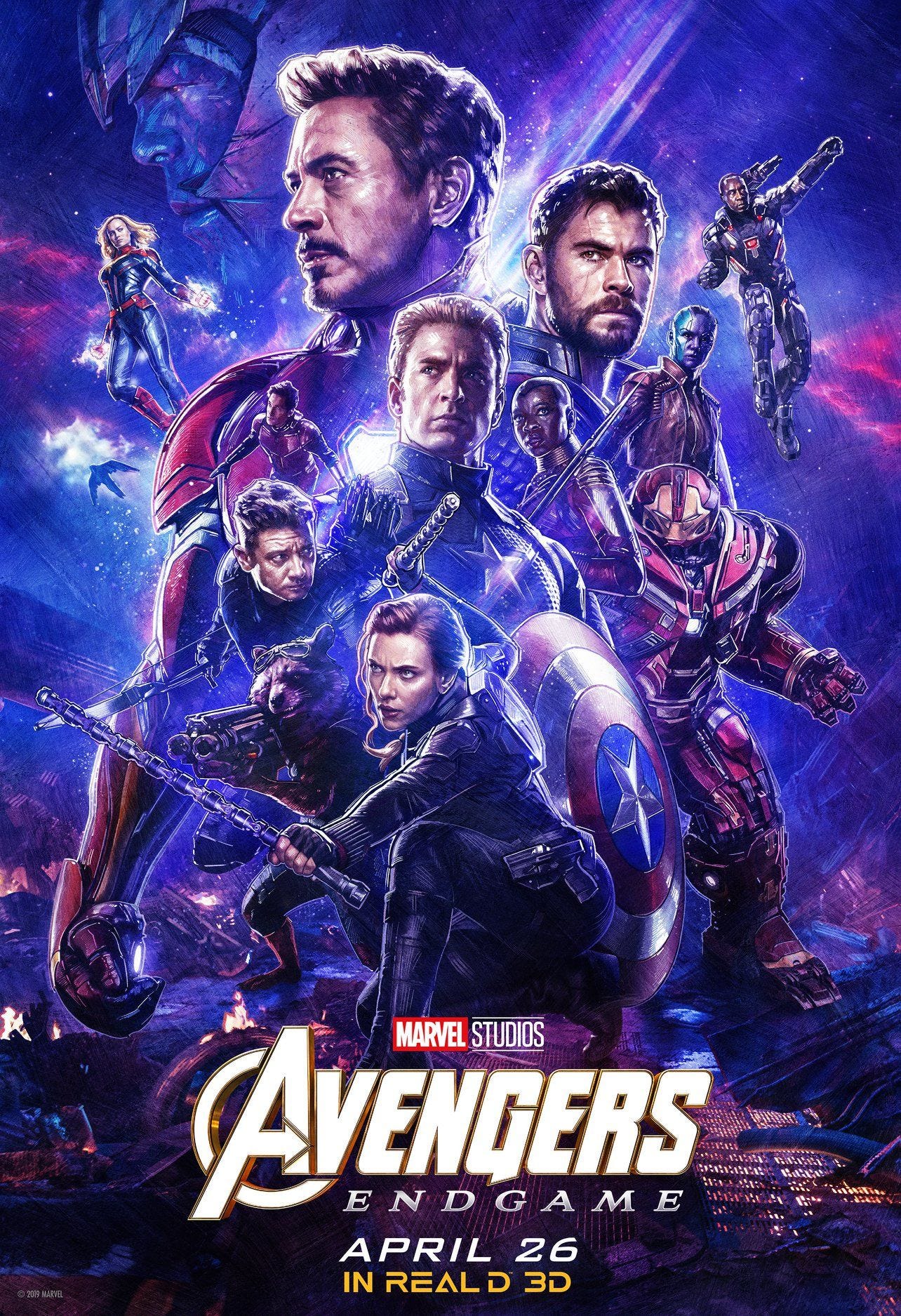
In fact, it generated tens of billions of dollars in revenue from 2008 to 2019, when “Avengers Endgame” premiered. SPOILERS—By the end of the film, Thor had given up his throne, Captain America gave up his shield and Tony Stark gave up his life. Three men gave away the things they’d spent their stories pursuing, and they did it all willingly and for the greater good. Rather than pursuing what they thought they wanted, they pursued what was necessary. The bad guy was defeated, the Universe was saved and tomorrow was assured.
THE TURN: REPRESENTATION AS VIRTUE
For ten years, global audiences cheered on avatars of traditionally masculine and feminine heroism and Disney/Marvel raked in the cash. After the conclusion of the ten-year Infinity Gauntlet storyline, the producers of the ongoing series opted to go in a different direction, motivated by post-Trump cultural blowback: Hollywood wanted to take revenge on people who reminded them that their internal ideology did not hold hegemonic control as they thought it did.
Driven by a need to impose identity politics on their earned audience, Marvel Studios produced an endless array of identity-focused content and the message was clear: White men were out and “marginalized” people were in. The previous slates of heroes: Thor who stubbornly transformed from entitled brat to self-sacrificing demigod; Steve Rogers from being a substandard physical specimen with a heart of gold and will of iron to a super-soldier enhanced by his virtues; and Tony Stark, globe-trotting billionaire playboy who ends up choosing to wield the greatest power of the Universe only to save all life at the expense of his own. These heroes earned their stripes, but the new direction of Marvel transitioned from earned competence to representation as virtue.
In unironically comical fashion, perplexed Marvel fans watched as former male heroes were sidelined in favor of gender/race-swapped reissues; formerly imposing villains like Loki were made to be punching bags for their female mirrors, completely defanging their once threatening demeanor.
A uniform rotation of White men—stand-ins for the built-in fan base—became villains while a menagerie of third and fourth-tier Marvel characters were adapted from the comics through a spectrum of Identity™. In the Disney+ show, Echo, a deaf Native American (Choctaw) amputee woman engaged in theatrical combat against muscled bad guys three times her size that shattered the suspension of disbelief. We were asked to celebrate her not because anyone could relate to her struggle, but because she represented three ‘marginalized’ identity groups. Her identity WAS her heroism. Everything else in the story was set dressing to frame her inherent awesomeness.
Nothing was created and everything was destroyed.
THE HUMAN CONNECTION TO GREATNESS
Prior to the Marvel saga, there was Lord of the Rings. Adapted from the series of books written by J.R.R. Tolkien and directed by Peter Jackson, the core and aesthetic themes of the telling were preserved. A Hobbit named Frodo Baggins lives in an idyllic paradise called The Shire where all is peaceful. He’s burdened with the responsibility of taking a magical ring from his home and across the land of Middle Earth to purge it into the volcanic mountain where it was forged.
A fellowship of Hobbits—including Frodo’s best friend, Sam, as well as Merry and Pippin—a contingent of men, a wizard, an elf and a dwarf follow him to the other side of their world to see this task to its end. All of the components that evoked classical storytelling were there: a masculine brotherhood from disparate origins and races, a seemingly insurmountable task, an antagonist force whose power seemed boundless, and a savage land indifferent to the plight of the heroes.
The story was ultimately about sacrifice. Frodo had no reason to leave the comfort of the Shire. His friends had no reason to follow him. The others had no obligation to escort Frodo likely to certain doom. They all took on a responsibility that was necessary. In the end, Frodo’s unbreakable will, Sam’s refusal to leave his side, the Fellowship’s losses and the strength of the unity of friends would see the promise to its end and Middle Earth would never be the same. The Lord of the Rings chronicled a true age of heroes.
Global audiences were enraptured and enthralled by the story. The films generated billions of dollars and billions more in merchandise sales. People the world over resonated with the themes of heroism, sacrifice, loyalty, masculine strength and feminine determination.
Recently, a woman watched the Lord of the Rings trilogy and was so taken aback by the majesty of its heroic story that she burst into tears and had to make a Tiktok to share. THIS is the power of heroes; this is the power of story.
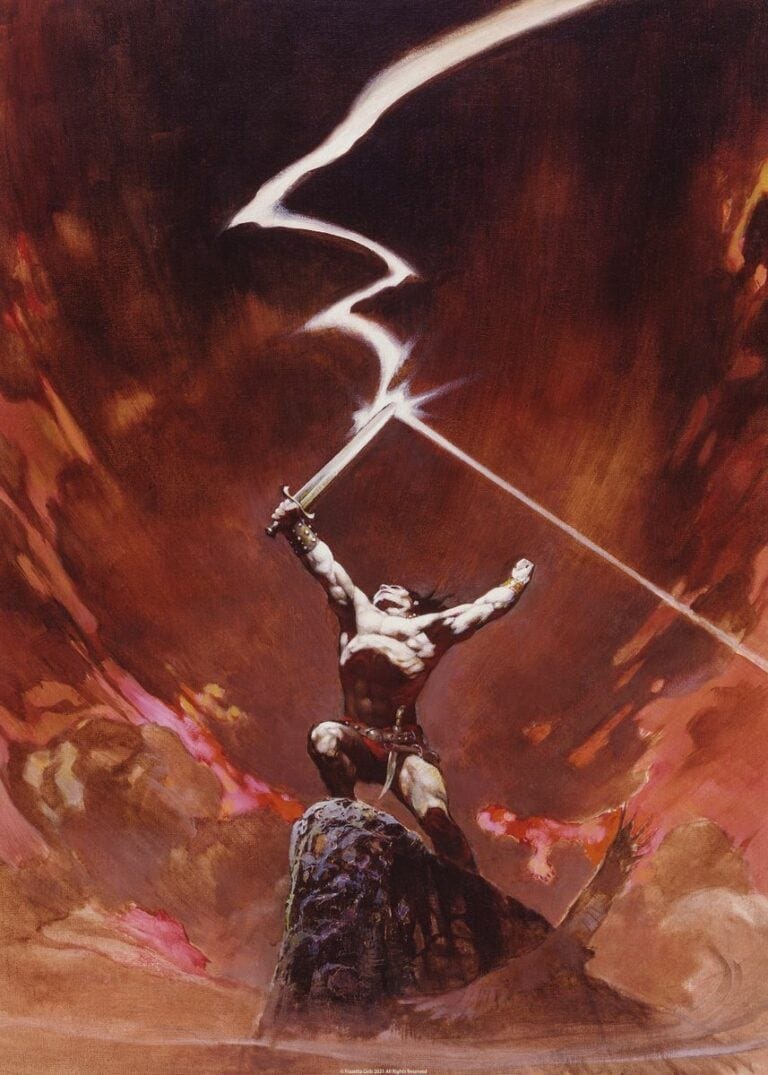
In Conan The Barbarian, James Earl Jones heightens the tension of the fantasy with a stellar performance as cult leader, Thulsa Doom. With Shakespearean passion, he waxes philosophical about the power of flesh to a beaten Conan, professing that the answer to the cryptic “Riddle of Steel” is that flesh is stronger than steel; Conan’s father tells him in his youth that “only steel can be trusted”. *SPOILERS* The story of Conan the Barbarian centers around the mission to solve the Riddle of Steel that his father imparts to him, and find the answer for himself. In the end, he learns that it is neither steel nor flesh that is strong—both of his mentor figures were wrong—rather it is the Will of Man that is strongest: the will to choose, the will to act, the will to rise above adversity. In the end, the answer does not bring the peace he thought it would. However, the realization of it defines him as a free man and as a hero, liberated to use his will to decide his fate. It’s a powerful message that men need to hear, especially now.
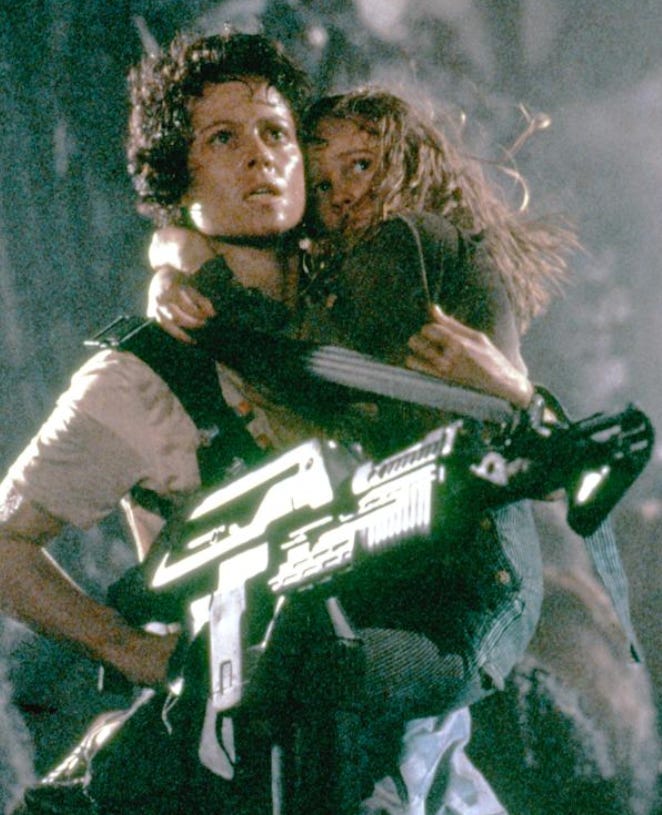
In 1986’s Aliens—SPOILER WARNING—Ellen Ripley awakens after being in space-born stasis for almost sixty years. She returns to a life where her daughter had grown old and died of natural causes. Ripley is called to action to serve as an advisor on an expeditionary mission to investigate distress signals from a remote human colony on the very planet she escaped from in the first film. The colony fell victim to a xenomorph infestation and the only survivor is a little girl named Newt. Ripley bonds quickly with her and adopts her as a surrogate daughter. In the end, she must enter the hivemind of the cold, calculating xenomorphs to save her daughter, even as the countdown clock for a self-destruct device threatens to atomize her and her few remaining allies. The power of maternal heroism supersedes any exclusive recognition of being female for representation’s sake. And the film is still widely regarded as a sci-fi classic.
Without a culture that lionizes behavioral tenets that lead to a healthy and sustainable society, a civilization will erode and decay until it crumbles into dust. This is where we are right now in the greater first world, whether it be the USA, Europe, Japan, China, South Korea, etc. In the pursuit of “social justice”, some are resigning entire civilizations to a slow, plodding death. The only thing that can reverse this course is a revivification of heroes and a recognition of objective morality. Centering a society on moral relativism is akin to building a home on quicksand; it will not stand for long.
REBUILDING CULTURE FOR A NEW AGE
Humanity innately responds to similar themes that bypass race, sex, language, age and even time. The heroic poems written two-thousand years ago inform the ones written now because the language of truth, beauty, love and strength are hard-coded into our DNA. When we create art that reemphasizes these tenets, humans respond in kind. When we try to subvert these truths, humans respond with confusion and derision. Those willing to create culture that revivifies that which civilization was built upon will be appreciated by those starving to watch heroes rise, fight and win again.
If you’re of the mind that modern western culture must be rebuilt, please help me to fix it by giving people alternatives to the endless array of corporate-subsidized anti-culture. I’m an author of genre fiction aiming to help provide a new foundation for a revitalized West. I’m doing my part, and if you’re willing, you should, too!
