


I recently had a Kickstarter project get funded for my horror/action novella, Hotel Erebus. I had already planned on doing a follow-up sequel to Hotel Erebus, but my business partner had a great idea; take the sequel to the book and use it to branch out into other media. I was intrigued…

BIG IDEAS DESERVE BIG PLATFORMS
So my business partner and I had this discussion a week or so ago about this video game he told me about called DOTA 2. It’s what’s called a “MOBA”(multiplayer online battle arena). I wasn’t particularly interested in the rules of the game or why people play it, but I was very interested in the vast and diverse roster of colorful characters people could play as. There’s over 125 “heroes” to choose from and if you check them out, it’s like a modern-day pantheon of forgotten gods and demigods. Each has their own little background and power-set; it’s all quite unique. The problem is these characters and the worlds they inhabit are entirely trapped within the confines of this very specific video game. There’s an artbook for DOTA 2, but I couldn’t find any actual books telling parallel or adjacent stories regarding their exploits and adventures.
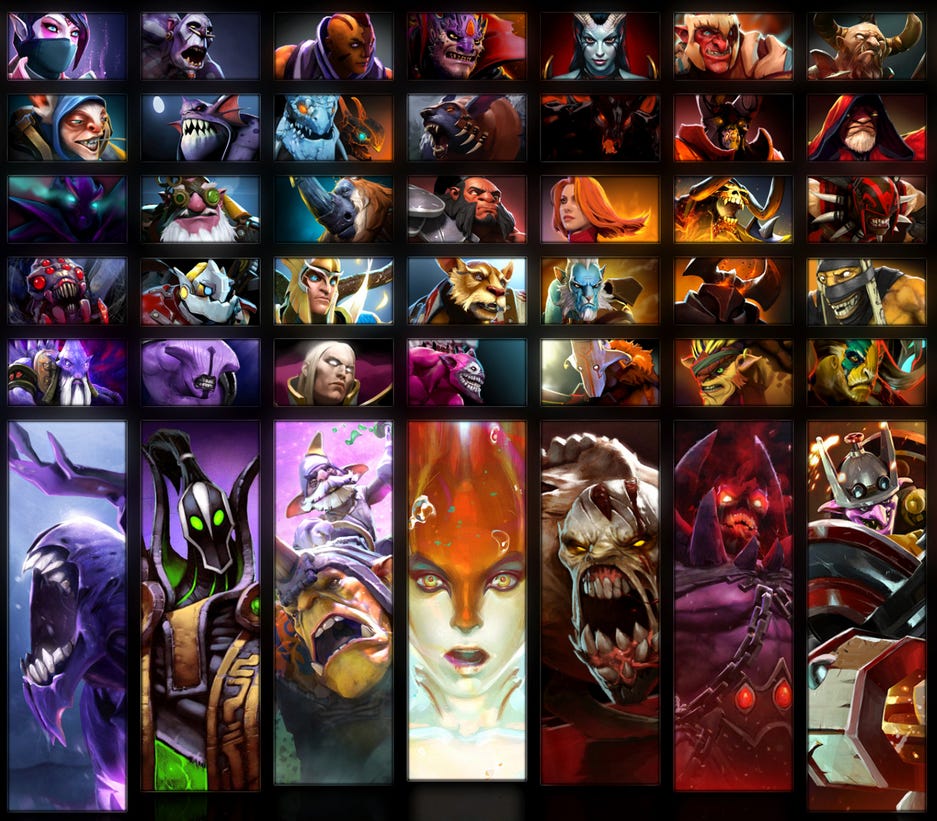
It just struck me that this incredible world had been crafted and its connective tissue woven for the various character dynamics, but it’s all relegated to being expressed exclusively through a very specific type of rules-based video game. That alone limits the extent that the narrative potential of these characters can be exploited.
Imagine Tolkien crafting the worlds and characters and languages and lore of Lord of the Rings and the ancillary novels, only to confine them exclusively to… a board game. That would be a bit of a mismanagement of development energy.
TRANSMEDIA FOR A NEW INDEPENDENT AGE
So back to Hotel Erebus; after having the DOTA 2 discussion with my business partner, I told him I wanted to do something within the world that Hotel Erebus exists in, but in a way that it could be explored beyond just books. He loves games, and while it can be a laborious and costly endeavor to make video games, other types of games exist that can also allow exploration of new worlds. These game types, specifically card games and TTRPGs(tabletop role-playing games) are less costly. He explained how he’d like to do a card game based on the world of Hotel Erebus. I thought that was an amazing idea. What was cool was this: as I crafted a narrative for the Erebus sequel that would introduce the breadth of this new world, he was coming up for rule sets within a card game to sufficiently capture the new characters and scenarios. We were coming up with a transmedia property in real-time, and the best thing was that it’s absolutely doable to make tangible.
It became quickly apparent that every idea we had for the card game directed us to some easily accessible third-party platform or affordable technology that would allow us to expand the idea. From creating custom board pieces using AI and 3D printing (text to 2D, 2D to 3D model, 3D model to 3D print), to getting a custom board printed through online vendors to using crowdfunding and online platforms like Kickstarter and Amazon to sell, it’s truly possible to build transmedia properties with very small teams of creatives.
Years ago, to create and distribute a property that was expressed through, say, a televised cartoon series and a toy line, you needed a massive team of animators, an expensive, expansive and extensive supply chain and distribution system to make the toys and get them in the brick-and-mortar stores. All of this constituted millions of dollars of capital investment. Now? A single person—or small team—could use one of any of the various AI video generation platforms to build out the ‘animated’ footage, use Davinci Resolve(a free video editor) to edit it all together and use YouTube to distribute to potentially hundreds of millions of viewers; the toys could be built using 3D printers and the packaging procured from online vendors. Distribute via USPS, Fedex or UPS and use free software like Stamps to print labels. The process went from taking potentially hundreds of people and millions of dollars and had been reduced considerably.
In 2026, for only a few thousands of dollars affording an entry point, a few people could access everything necessary to make a super-cool property and express it in a variety of ways to a global market. My business partner and I are going to do just that. The currently unnamed card game will likely be launching on Kickstarter after our dark fantasy novel, CLEAVE, concludes its Kickstarter campaign. CLEAVE will be launching on Kickstarter in a few weeks after Hotel Erebus orders are fulfilled.
If we can do it, any of you can! If you have an idea, don’t presume it has to stay imprisoned between your ears. Give your ideas a chance to live!
Stay frosty.
SARJ OUT
