ORIGINS OF FUTURESHOCK
It’s impossible for us to know what the future holds. However, the trajectory of technology has been moving on an upward swing for centuries. The effects of this have been illustrated in various forms of media.
Frank Herbert’s Dune was written in the 1960s and likely conceived in the late 1950s. In many ways, Herbert was a literary genius, but he was a man of his time. The concept of artificial intelligence was coined in the mid-1950s, around the same time the author likely began to conceive of the foundations for Dune. He set the story ten-thousand years into a future of a human race parallel to us; the planets in the story are completely different, but the principle characters are humans that speak English. This gave Herbert creative license to take the story in different directions.
Ten-thousand years is an eternity when layered on top of human technological advancements. By the late 50s, the early foundations for what would become our modern Internet were being devised. By 1969, ARPANET was created by the US Government, which was a network that implemented packet switching technology. This tech would pave the way for interconnected computer networks in vast meshes: the Internet.
From the Stone Age to the Iron Age to the Industrial Revolution to the Information Age, humanity has moved rapidly along an exponential curve towards a technological phenomenon we don’t truly understand and cannot intuit based on our biological computers that have taken millions of years to slowly evolve and develop. This is putting us into precarious—but potentially miraculous—times. But for Frank Herbert, a man wanting to write a science fiction novel set ten millennia into the future, the seeds for solving many of his narrative obstacles were inherent in the very technological progress he was writing about.
In Dune, humans developed artificial intelligence which eventually was physicalized into humanoid machines. These machines tried to subjugate the human race until we fought back and destroyed them in a campaign called the Butlerian Jihad. Eventually, humans would ban artificial intelligence entirely, moving us towards a humanistic form of technology that forced us to evolve our minds and bodies rather than rely on machines. Frank Herbert was clever in that he eliminated the need to create fictional technologies that might exist in ten-thousand years by making it a plot point that the very mechanisms that would allow us to do so are made illegal. Genius.
In fact, within the Dune universe, personal force-field tech even reduces the desire for projectile-based weapons. This is due to the fact that a speeding impact into a force-field would result in an explosion on a thermonuclear level. Therefore, men began to fight with knives at close-range to mitigate this mutually-assured destruction. In the distant future, we use advanced defensive tech to fight like stone-age brutes. Regression becomes progression. More genius.
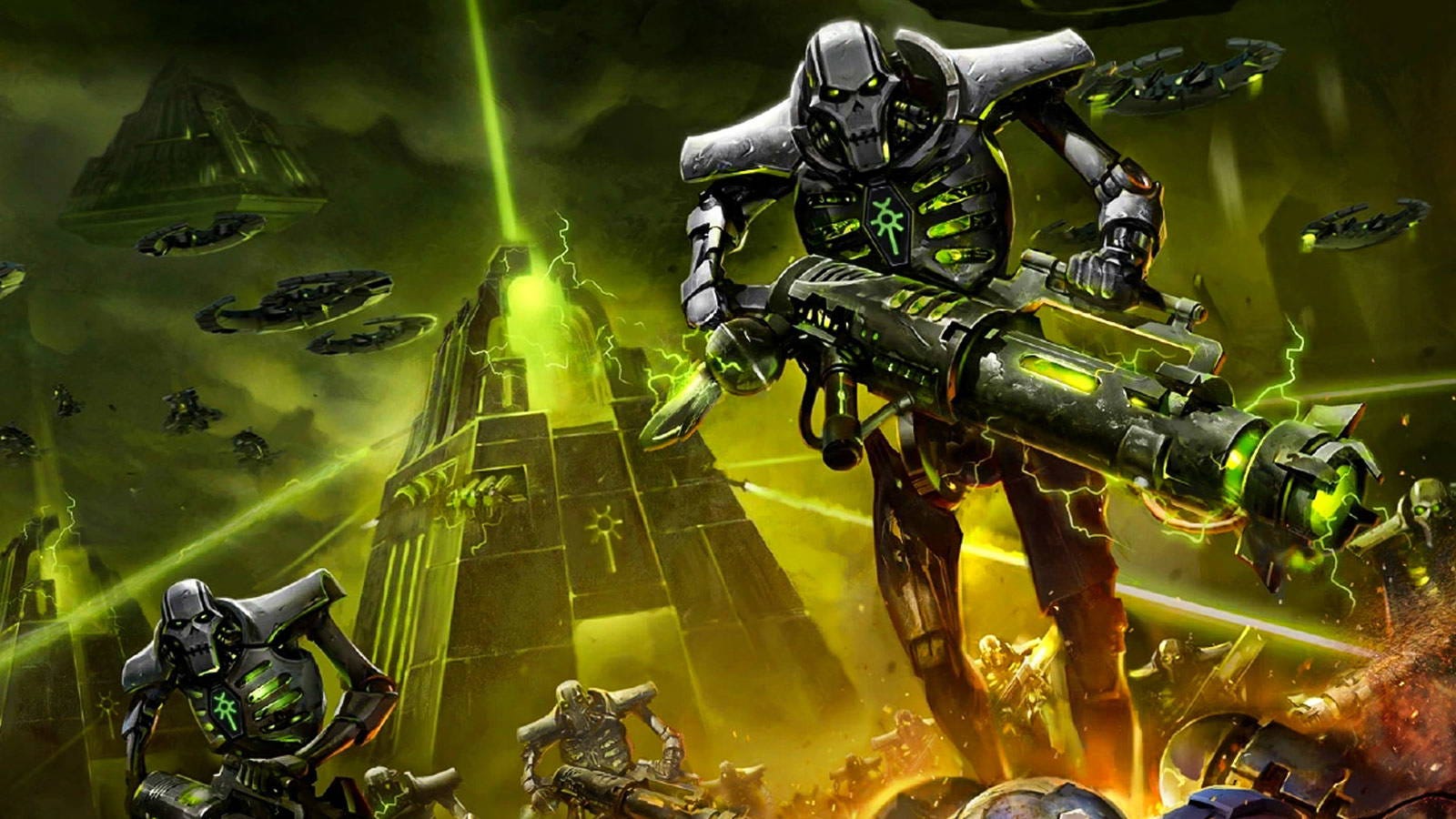
In Warhammer 40K, humanity tread a similar path leading to a future consumed in unending warfare. In that universe, malicious AI—referred to as “abominable intelligence”—is just one threat, but it is a significant one.
THE BLIND SIDE
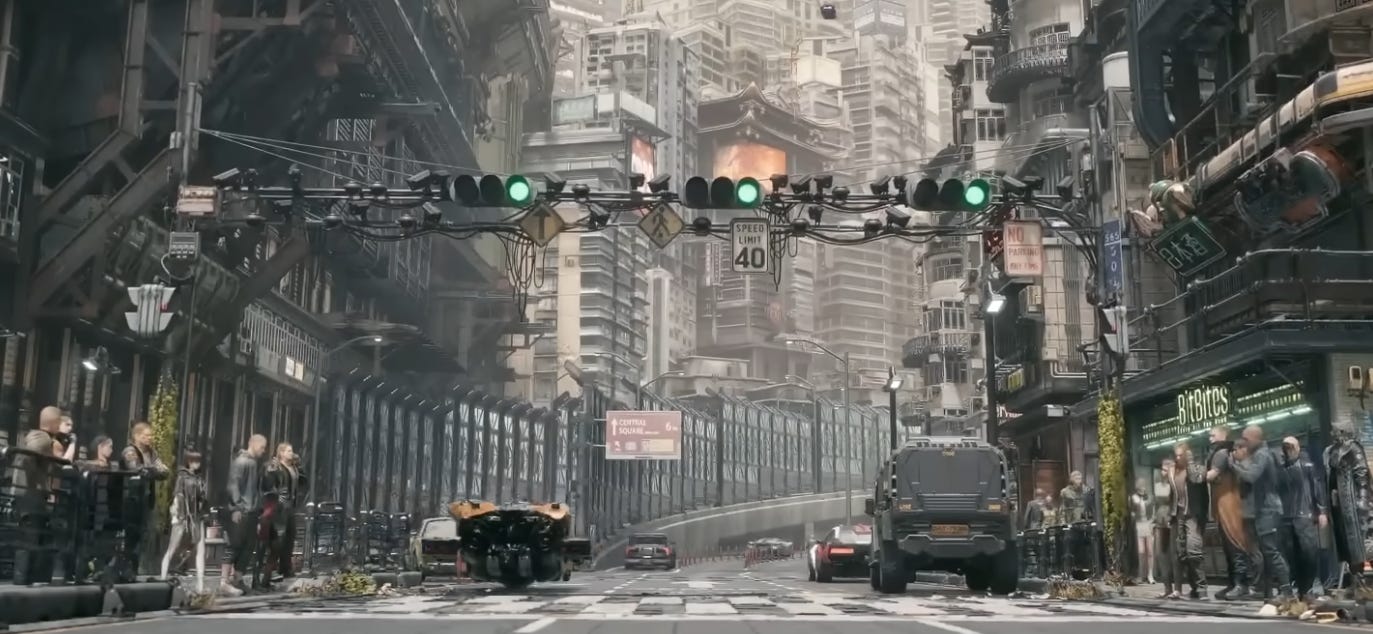
The problem with sci-fi is how often things can appear antiquated in the present day that are still portrayed in the future. In games like Cyberpunk 2077 and Stellar Blade: Blood Rain, people are shown driving cars everywhere even as we are currently in the process of mass implementation of self-driving cars. By 2077, self-driving cars will have had decades to revolutionize ground-based transport in ways we can’t currently imagine. Will people even need drivers’ licenses anymore? Will traffic lights exist? Will it be illegal at some point for humans to even operate road and air-based vehicles?
If progress is moving as fast as it is, fifty years from now will become increasingly unpredictable. Blade Runner portrayed flying vehicles and humanoid replicants, but people still read newspapers and used disc-based media. However, having made that case, authors like Herbert were at least aware of the coming blindsides and planned accordingly in their myths to seamlessly address the issues and make them foundational to the lore.
In Star Trek, we’re shown massive ships filled with human beings in traditional maritime managerial hierarchies traveling the cosmos to gather data to help progress human/alien relations. There’s a captain who delegates responsibilities to people running around a ship. In a few centuries, wouldn’t it be more likely that unmanned drones would gather all of this data? Would humans need to be present to achieve these ends? AIs that can process staggering levels of data in a femtosecond could use predictive models to execute plans to further human goals. We’re not just looking at a hockey stick; we’re looking at a hockey stick that accelerates at light-speed. Writing fiction about this future will become increasingly difficult. And the idea of writing books about a future of unparalleled technological developments is not lost on me.

STRANGE FUTURES
The future of the human race has many potential branches: in a thousand years we could be long-extinct, or we could live on dozens of colony worlds in various form factors that allow us to perpetually preserve our individual consciousnesses.
Regardless of the outcome, some questions remain: How will we process stories in the future? Will they even matter? Will human beings develop into something that will be as unpredictable as our technologies?
In 2026, human beings consume more media in one day than people consumed in the entirety of their lives not that long ago. We have access to thousands of years of books, hundreds of years of photos, a century of film, decades of video games, mountainous amounts of social media content, streaming video, AI-generated audio and more.
We seem to be transitioning away from a human-centric economy to a AI-centric economy that will be almost entirely automated. The hope/expectation is that dividends from mass automation—direct and indirect(via deflationary forces derived from millions of humanoid robots working endlessly on 7-days schedules to produce stuff at negligible cost) will transition humanity into a new age of active abundance. This will leave people with immense amounts of time to consume media.
This obviously sounds like a beautiful dream, however, there is a dark cloud here: with such abundance, will deflationary effects also lead individual artistic expressions to be worth less? Not worthless but worth less. Over the course of the last few decades, the Internet and easy access to music has made it increasingly difficult for musicians to sell their art. It’s packaged up and is accessible electronically via online platforms like Spotify and Apple Music for relatively low-cost. This is great for consumers but less so for the people creating the media. People generally seem to find music less valuable than in the past when it existed only on the radio and in physical formats.
Will the human race’s trajectory follow Dune’s? Star Trek’s? Warhammer 40K’s? Or something else that’s better… or worse?
NEW BOOK
If you’re interested in being introduced to a new world of gods, monsters and machines, NECROPOLICE: BLOODSTORM may be what you’re looking for.
The 170-page novella written by S.A. Reyes-Jones is currently funding pre-orders on Kickstarter.
The story centers on Necropolice agent Ursula Graves who is sent away from the dreary confines of an urban sprawl called the Necropolis and on a mission to recover a missing fellow agent. Her mission takes her to a quiet, pastoral village called Belarad. The villagers are afflicted with some kind of plague that has turned them into monsters. Ursula discovers that the key to completing her mission requires her to deal with demons from her past. Will she save the day? Find out in NECROPOLICE: BLOODSTORM.

SARJ OUT