


I’m currently writing Mad Malitia, a cyberpunk sci-fi novel set in the year 2147. It’s a story about a tough, audacious and super-sexy female security officer in the future who rides a motorcycle, has a huge sidearm and is practically poured into her skintight black outfit. Curves, cleavage and carnage. Pretty easy, right?
The problem is that once I started actually plotting it out, I realized that the story demanded to be more than simple sex-ploitation pulp, which is what the original intention was. It really hit me that I’m writing a story set in our world, but fast-forwarded 120 years. The problem there is that modern tech is advancing so quickly that the risk of my book seeming antiquated in just a few years is definitely possible.
For those keeping a watchful eye on the slope of modern technology, it seems to be advancing along a hockey stick trajectory. If you’re not an initiate in the ongoing, perpetually changing landscape of tech and AI, a significant portion of the discourse might sound like the transcript for either the writers’ room for a sci-fi streaming show or a psychiatric session. In between getting daily updates on tech, bio-science and AI via Grok, watching podcasts on YouTube like Moonshots, keeping up with Elon Musk’s X post feed and catching up on other news via YouTube, it’s easy to see just how rapidly science and tech are dipping their toes into nigh-magical territory.
SCIENCE FICTION BECOMES FACT
Mass drivers on the Moon. A 100-million square foot chip fab to produce AI chips in Texas. Fleets of self-driving cars. Autonomous humanoid robots. Drone delivery systems. Legions of agentic AIs talking and philosophizing and organizing among themselves independent of human interaction. This isn’t a century from now; this is now. Where will we be in a century? That’s the question I’m trying to answer in this newest book, Mad Malitia.
However, unlike many dystopian cyberpunk tales, Mad Malitia is actually an optimistic, multi-layered story about what defines ethical use of agency and how consciousness is valued in different classes within society. Perhaps a machine, if given the chance, would love to enjoy the privilege of consciousness whilst other human beings might opt to deny themselves the responsibility of autonomy altogether. These post-abundance humans might choose to shuck off the limitations of the real world in favor of a persistent lucid dream that they control.
In our world, there’s a small but surprisingly significant contingent of prison inmates that, upon being released into the free world, actually yearn to return to the regimented and strict paternalism presented by the prison system. Inside, everyone is treated like a child and personal responsibility is limited. In exchange for incarceration, you cede the rights to dictate your own path in life: no freedom but also no responsibility. How do we navigate this unique forest of psychological nuance? These are the questions that will be asked in Mad Malitia.
WRITING FOR A FAST-APPROACHING FUTURE
I’m deeply ensconced in research of near-future tech, but even I have to admit that it’s difficult to maintain a firm grasp on the rapidly iterating future. I still don’t fully understand how Bitcoin works—other than it uses mathematical computations to generate a form of value. Passive, agentic AI is here, but for all that I use tech for, I haven’t dipped my toes into that even though I know it’ll be a key component of future businesses and daily life. It’s literally mind-boggling.
I often get confused while I’m doing research for Mad Malitia because the tech is changing by the day. Interesting statistic: only 12% of people who own Tesla cars utilize its full self-driving feature in which the car uses a network of on-board cameras, computer vision and advanced AI to drive the car without human assistance, and a seemingly vast number of owners aren’t even aware of the feature’s existence. In cities like Phoenix, Oklahoma City and Austin, Texas, groups of self-driving cars are already provide taxi services to hundreds of people. Within a generation, the idea of driving a car will be as crude and laughable as riding a horse to work.
In another example, a robotics company called Figure recently featured one of its autonomous humanoid robots to news agencies around the world, as it was escorted through the White House by First Lady Melania Trump. In a few generations, visibility of these types of bots will be completely and inextricably ubiquitous.
The seminal science fiction film Blade Runner was released in 1982. Based on the Philip K. Dick novel, Do Androids Dream of Electric Sheep, Blade Runner imagined a world—set in the then-future of 2019—where synthetic humans were engineered to serve as slaves to the human race(ironic that the actor Rutger Hauer who played the icy synthetic human, Roy Batty, actually passed away in 2019). Now in 2026, the subject of AI and advanced humanoid robotics is becoming a point of serious debate and contention. There is a serious anti-AI fervor among the general public and unironic robophobic language is beginning to manifest in daily parlance in first-world nations where labor forces will be the first to be adversely affected. A boiling tension is building that our current economic system doesn’t seem designed to contend with. Something’s got to give, right?
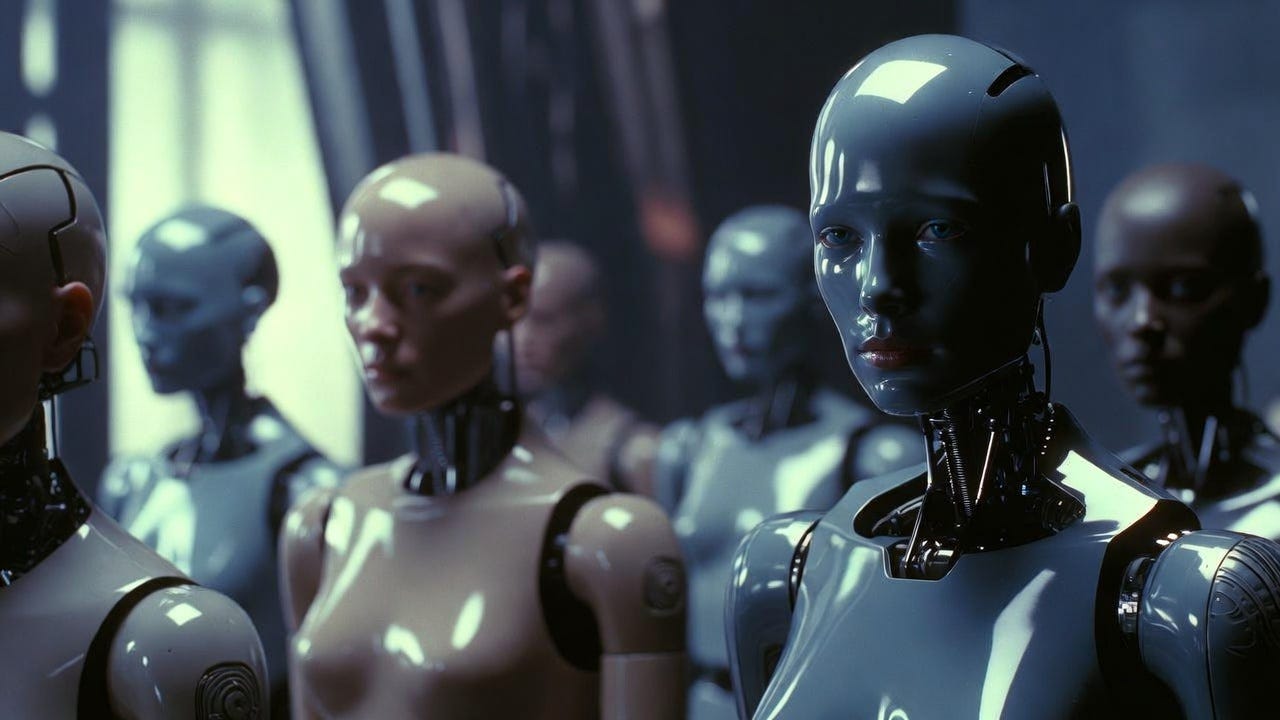
There’s a strange comfort in writing a book whose story is set a century from now. I can craft any scenario I want to explain how we get through this tempestuous time. As Mad Malitia develops, I am constructing a future world that has somehow survived the current, uncomfortable, anti-Goldilocks zone of human labor deflationary effects as AI and automation ramps up. The hope is that this era of granular discomfort leads to an age of unparalleled abundance and a thriving global society.
With all of the trends pointing to tech solving problems like aging, diseases, output inequality, energy needs, .etc, a future world will still pose threats to humanity—in all its forms—and freedom. Those threats constitute the kinds of drama that attracts humans to recognize and agree upon shared values. No matter how far we go and how much tech improves, humans will always love a good story. With Mad Malitia, I hope to deliver.
You can preview the live pre-launch Kickstarter page for Mad Malitia here: kickstarter.com/projects/stratum/mad-malitia-cyberpunk-novel

SARJ OUT